
Every contractor eventually gets the same pitch. An SEO company calls, promises page one rankings, and hands over a contract for $800 a month. Six months later the phone isn’t ringing any more than it was before, but the invoices keep coming.
That happens because most of what gets sold as “local SEO” for trades isn’t built around how people actually search for a plumber, an electrician, or a roofer. It’s a generic package built for e-commerce sites and stretched to fit a business that lives or dies on a five-mile radius and a phone that rings. Here’s what actually matters, and what’s mostly a waste of your budget.
What actually moves the needle
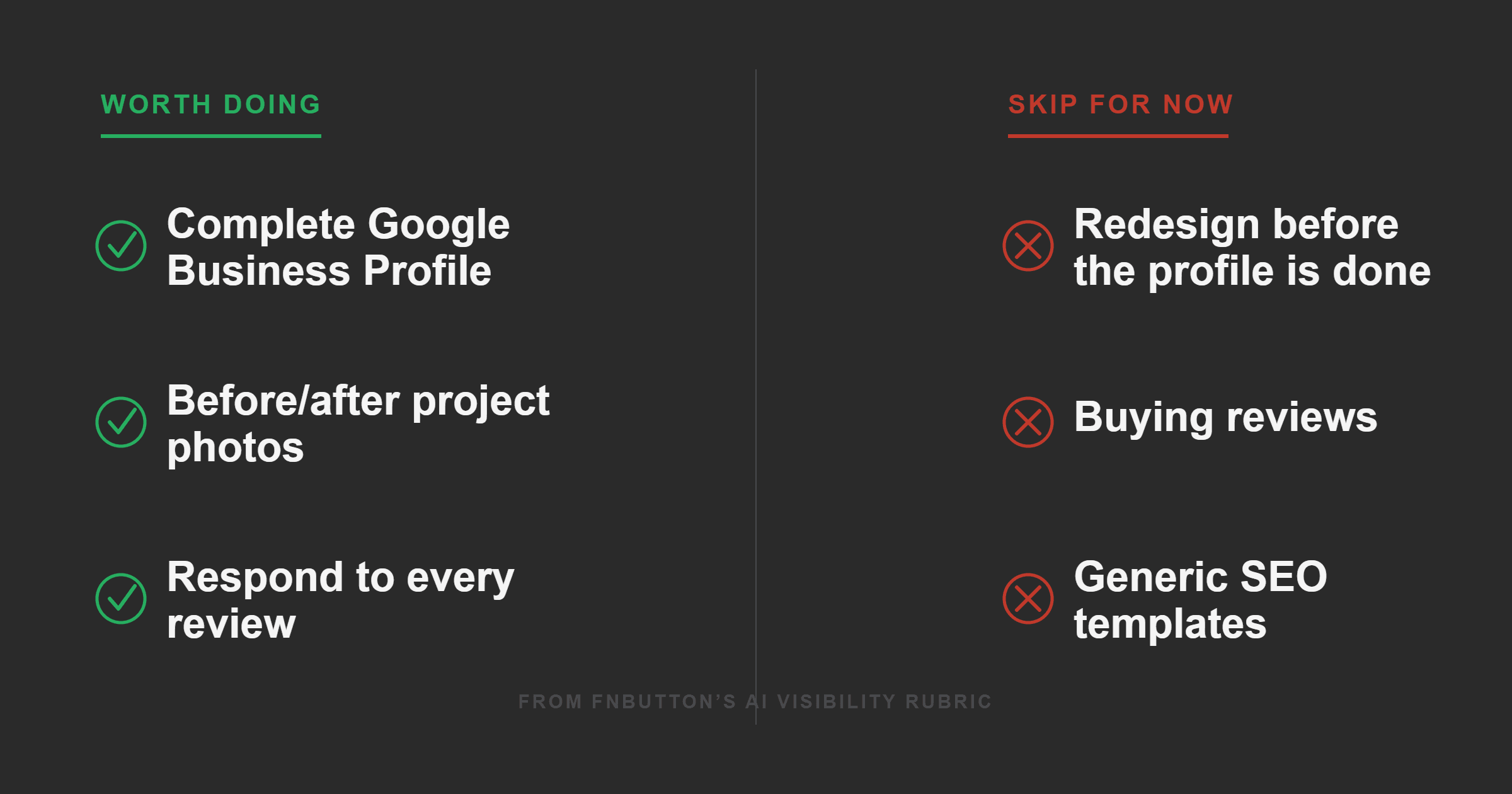
Your Google Business Profile does more work than your website. For local trades, this is the single highest-leverage thing you can control. Full service list, real categories (not just “Contractor,” the specific ones: “HVAC Contractor,” “Roofing Contractor,” whatever actually applies), current hours, and photos of real jobs, not stock images. Google Business Profile posts and the Q&A section get checked more than people expect. An empty or half-filled profile is the local-SEO version of leaving money on the table.
NAP consistency is boring and it still matters. Name, address, phone, exactly the same everywhere: your website, Google, Yelp, Facebook, the industry directories, the Chamber of Commerce listing. One digit off on a phone number across two directories is enough to quietly cost you trust signals you’ll never see missing. This is tedious, unglamorous work. It’s also one of the few things in local SEO that’s fully in your control and fully verifiable.
Reviews: volume, recency, and whether you actually respond. A contractor with 60 reviews from three years ago loses to a competitor with 25 reviews, half of them from the last two months, every time. Recency signals you’re still operating and still good. Responding to reviews, especially the occasional bad one, tells both Google and the actual human reading it that someone’s home.
Service-area pages, built for real cities, not one generic page. If you cover six towns in the Tampa Bay area, six real pages beat one page that lists six city names in a sentence. Real means actual content specific to that area: neighborhoods you’ve worked in, permit quirks specific to that county, a review or two from a customer there if you have one. Thin, duplicated pages with the city name swapped out don’t fool anyone, least of all Google.
Local SEO was never about tricking an algorithm. It’s about making sure the truth about your business, that you’re real, local, good at the work, and easy to reach, is somewhere Google and every AI system after it can actually find it.
Local citations and backlinks from sources that are actually local. A link from your county’s home builders association or a mention in the local paper carries more weight than ten generic directory listings that exist purely to sell backlinks. Suppliers, trade associations, and local news are underused sources most contractors never think to ask.
What’s usually a waste of the budget
Chasing broad national keywords (“best plumber,” no city attached) when your business only serves a 20-mile radius. Blog posts padded out with generic “5 tips to maintain your HVAC system” content that nobody in your actual service area is searching for. Backlink packages from sites with no connection to your trade or your region. And redesigning the whole website before the basics above are even in place, since a beautiful site with an incomplete Google Business Profile still loses to an ugly one with a complete profile and 80 recent reviews.
The part that connects to everything else
Here’s the thing nobody selling generic SEO packages tells contractors: the exact signals that make Google trust and rank you locally, an accurate Google Business Profile, consistent NAP, real reviews, real service-area content, are the same signals AI assistants read when someone asks ChatGPT or Gemini to recommend a contractor nearby. This isn’t two separate jobs. Getting found on Google and getting recommended by AI search draw from the same foundation. Fix it once, it works for both.
That’s not a reason to treat local SEO as an afterthought to AI visibility, or the other way around. It’s a reason to stop paying for two disconnected efforts when one solid foundation covers both.